Business and Entrepreneurship Training: Unlocking the Agribusiness Potential of Maize.
Finding a business niche within South Sudan’s agricultural sector has long been a challenge, particularly for farmers and cooperatives involved in the maize value chain. Most focus on traditional grain production, leaving other lucrative aspects of the value chain untapped. However, the Hipaigba Cooperative, a farmers’ group of 25 members (12 male and 13 female) in Nzara County, is breaking the mold.
Earlier this year, through the Small Agriculture Market Support (SAMS) project, cooperatives in Western Equatoria State received business and entrepreneurship training. This training sparked a ground-breaking idea: instead of just selling maize grain, which is labor and time-intensive, why not diversify into fresh maize sales? With this new strategy, Hipaigba Cooperative quickly planted 8 feddans of maize, which is now ready for market.
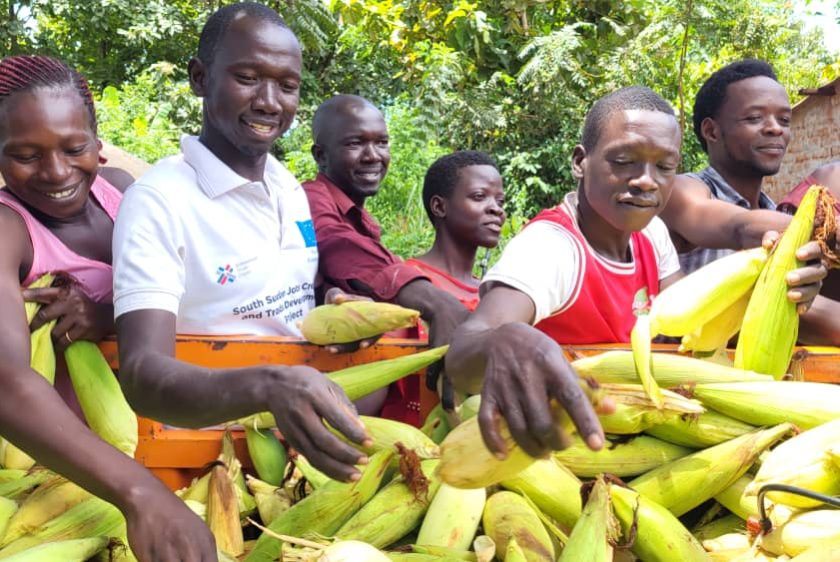
The SAMS team facilitated market linkages and transportation, allowing the cooperative to reach buyers in Yambio. As Tiiti Martin Angelo, the cooperative’s secretary, shared, “It seemed surreal. Retailers from Yambio flocked into our rickshaw, and in no time, all the fresh maize got over.”
In recent years, maize products such as boiled maize, roasted maize, and maize bread have become popular street foods in Yambio, increasing the demand for fresh maize. Selling fresh maize has proven to be a smart business decision. Each day, the cooperative supplies a rickshaw full of maize to Yambio, selling it at 1,000 SSP for four cobs, earning around 450,000 SSP per trip. With an entire 8 feddans of maize, they’re set to achieve financial returns far beyond what they would make from selling grain alone. Through economic analysis skills gained through the business and entrepreneurship skills training, the group quickly realized that its is more profitable to sell fresh maize than similar quantity of maize as grains.
“We’re now thinking big,” said Henry Ankangelo, chair of the cooperative. “With the profits, we plan to expand into pineapple farming and beekeeping, to stay ahead of the game in the face of climate change.”
The SAMS project, supported by the World Food Programme, is an example of how targeted skills training can unlock the vast potential of agribusiness in South Sudan. By empowering cooperatives like Hipaigba, these initiatives are steering real socio-economic change, building a sustainable future for communities across the country


